

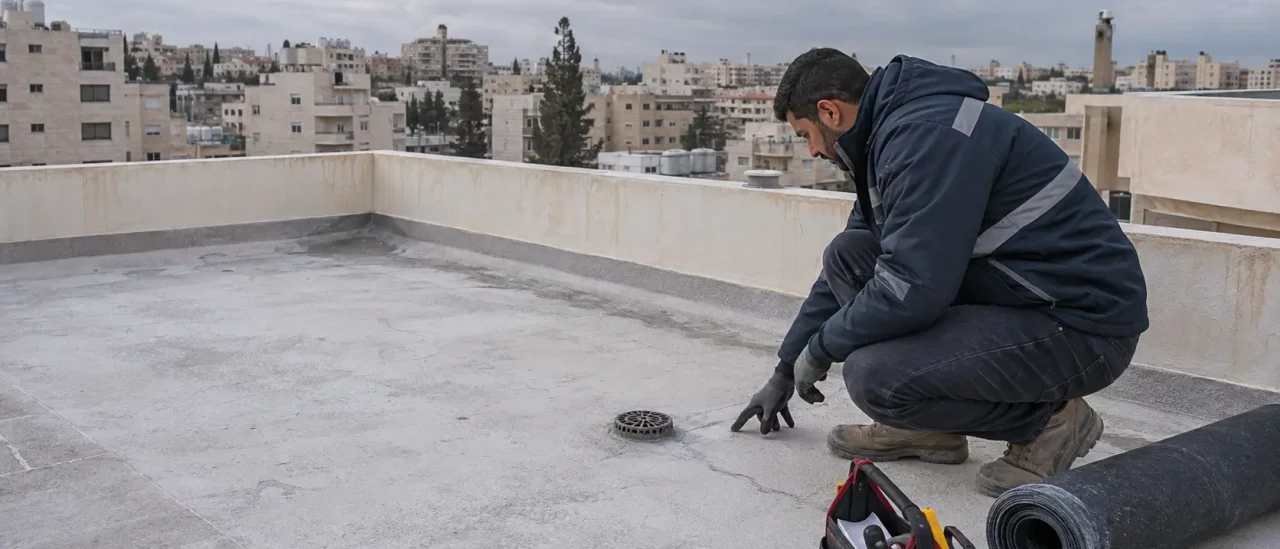
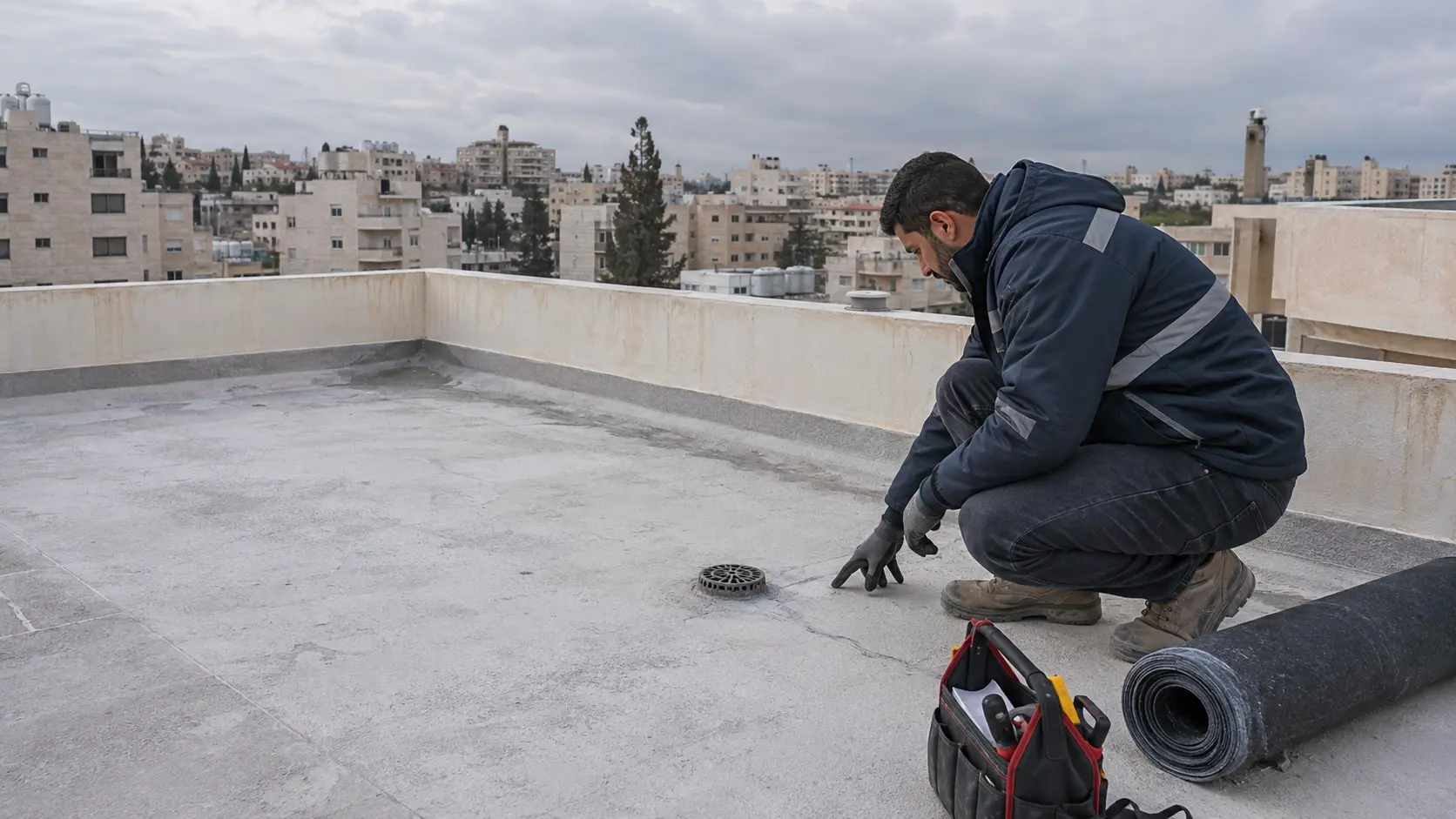
Protecting your home from winter rain starts before the first storm, not after a damp patch appears inside a room. Waterproofing a roof against rain closes the paths water uses to get in and treats the weak details — cracks, joints, edges and roof drains. But it only works if the cause is diagnosed first and the roof is prepared properly.
In Jordan’s climate, a roof faces sun and dust through the year, followed by rain and cold. This constant change can affect old waterproofing layers, especially where water pools around the drains or cracks appear where the roof meets the edges. That is why buying a waterproofing product and applying it straight away is not enough — what you need is a complete system that starts with an inspection and ends with checking the details after the work.
If you want the work done straight away, see our roof waterproofing service in Amman and Jordan. This guide explains how to tell whether your roof needs treatment, which steps to take before winter, and how to choose a solution without spending money on a temporary layer that only hides the problem.
Quick answer: how do you protect a roof from rainwater?
- Inspect the roof and find where the water gets in, rather than relying only on where the damp shows inside.
- Clean the roof and remove weak sections and loose remains of old materials.
- Check the falls, clear the rainwater drains and treat areas where water pools.
- Repair cracks and joints, the bases of tanks and air-conditioners, and where the roof meets the edges.
- Choose a waterproofing system that suits the condition of the roof and how it is used.
- Cover the fine details, then check the layer after application before handover.
Signs your roof waterproofing is weak before winter
- Yellow or dark patches on the ceiling: they may appear straight after rain or spread gradually as moisture stays inside the building layers.
- Flaking paint or bulging plaster: a sign that damp has reached the interior finishes — but on its own it does not show where the water gets in.
- Water pooling on the roof: pools around the drains or in low spots put extra stress on joints and weak points.
- Cracks at the edges and joints: the areas around the parapet, tank bases and pipes need more attention than the open areas.
- Old waterproofing bulging or lifting: membranes or coatings that have lost their bond can let water in underneath.
- A damp smell on the top floor: especially after rain, sometimes with a cold spot or a change in the colour of the ceiling.
The damage inside is not always directly below the source of the leak — water can travel through the roof layers before it shows on the ceiling. When the source is unclear, water leak detection without breaking helps tell a rain leak from a pipe or tank leak.
Where do rain leaks usually start?
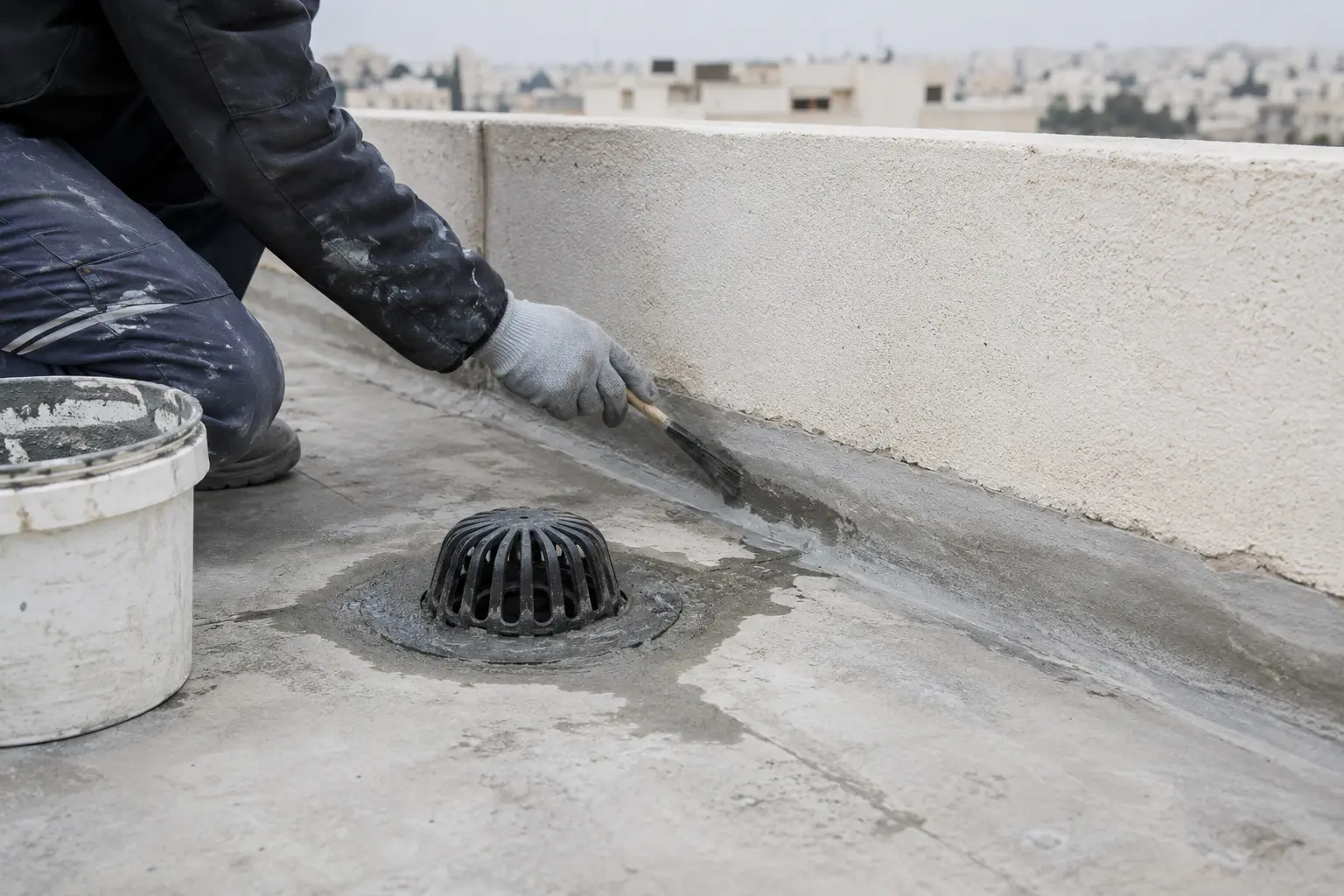
Rainwater drains
A drain may be blocked with dust or sit higher than the surrounding area, so water collects instead of draining away quickly. The joint between the drain body and the roof surface also needs careful treatment, because it is exposed to movement and expansion.
Where the roof meets the wall
The upstand is not a cosmetic detail — it is where the waterproofing changes direction. If the material stops at the floor and does not turn up the wall properly, the edge can become a path for water.
Tank, air-conditioner and pipe bases
Anything fixed through the roof, or that blocks the flow of water, needs checking. You should also make sure the damp is not coming from a roof tank or a water connection — if you suspect it is, see our tank leak detection service in Amman and Jordan.
Cracks and old layers
Covering a crack with a thin coat may not be enough if the crack is moving or reaches deeper layers. Nor should a new material be applied over sections that are detached or bulging — the strength of the new layer cannot make up for a weak surface underneath.
How to waterproof a roof against rain properly
1. Inspection and scoping the problem
We review the signs of damp inside the building and the condition of the roof outside, checking the drains, edges, joints and the areas around equipment and tanks. The aim is to find out whether the problem is local or whether the whole waterproofing layer has reached the point where it needs renewing.
2. Cleaning and preparing the roof
The roof must be clean and sound before application. Dust, weak sections and loose materials are removed, and the roof is left to dry according to the requirements of the system used. Applying waterproofing over trapped moisture or a dirty surface can lead to bubbles and detachment.
3. Repairing the details and the falls
Cracks, joints, the areas around drains and junctions are treated before the main area is covered. If water pools because of poor falls, simply applying a thicker coat will not solve the problem — the drainage must be improved or the low area corrected, depending on the roof.
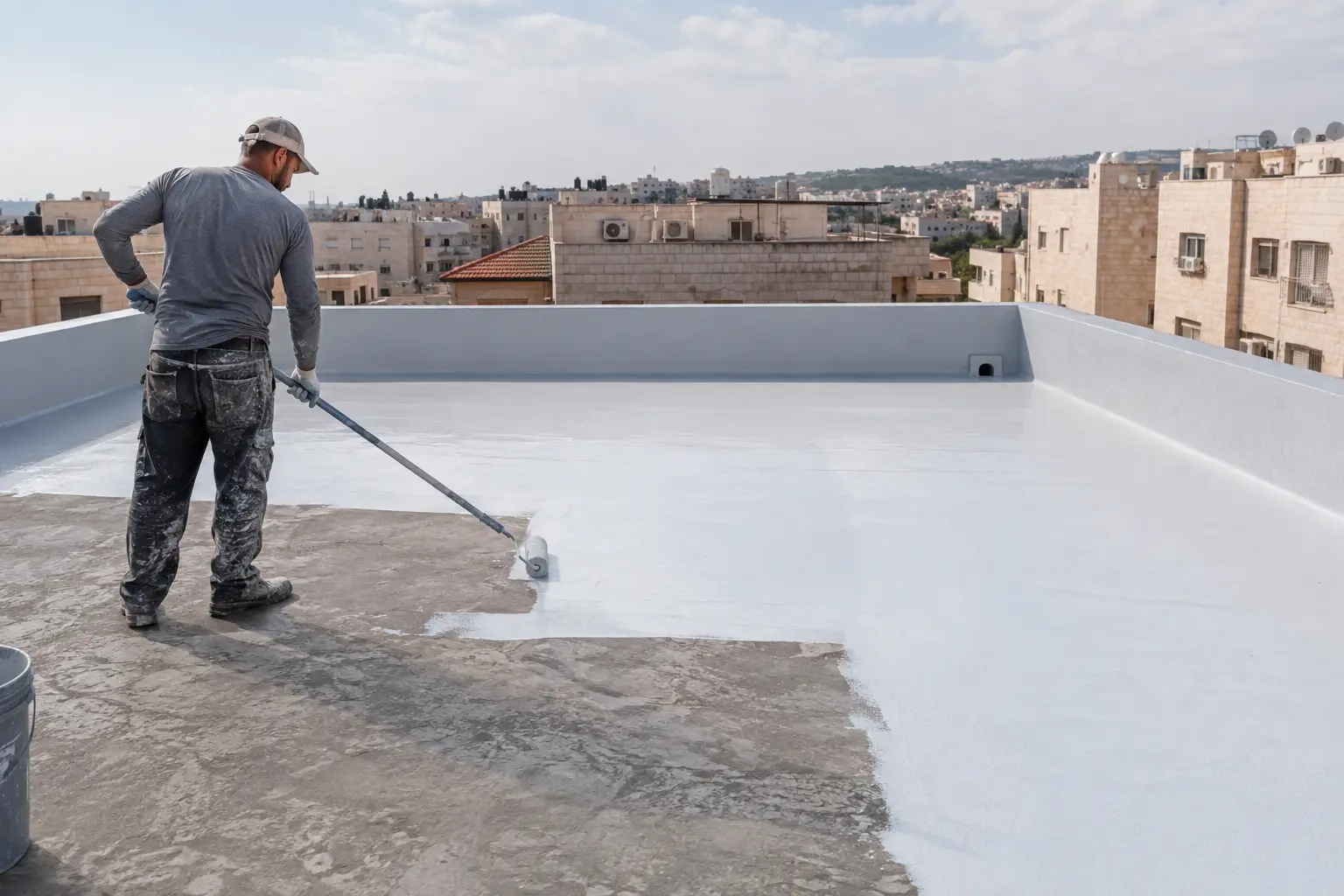
4. Applying the waterproofing system
The system is applied according to the product’s instructions and the site conditions, with attention to continuous coverage, the edges and any penetrations. The number of coats, their thickness and the drying time are not the same for every product, so they are set by the chosen system rather than a general rule.
5. Checking and handover
Once the application is complete, the coverage, drain points and edge details are reviewed. The client is also given instructions on using and maintaining the roof and on the warranty for the system installed, because sharp objects or new fixings after waterproofing can cause local damage.
A quick comparison of roof waterproofing systems
| System | Usually suits | What to check first |
|---|---|---|
| Elastic coatings | Sound roofs that need a continuous layer with treated details | Cleanliness, dryness, cracks and compatibility with the old layer |
| Bitumen membranes | Roofs suitable for rolled membranes with proper laps and edges | The condition of the base, the falls, the laps and the details around drains |
| Polymer-modified cementitious waterproofing | Some roofs and concrete details, depending on the system | The soundness of the concrete, movement and direct exposure |
| Polyurethane foam | Projects needing thermal insulation and a continuous layer as part of a complete system | Application thickness, the final protective coat and the condition of the roof |
No single system is best for every roof. A tiled roof is different from exposed concrete, a roof used every day is different from one that is not, and old layers or trapped water change the treatment. The right choice starts with an inspection, not with the name of a product.
Can a roof be waterproofed over the tiles without breaking?
In some cases, yes — when the tiles are firmly fixed, the joints can be treated, and there is no trapped water or loose material under the surface. But if the tiles move, or the problem lies in the falls or the layers underneath, applying over them may only be a temporary fix. That is why the roof must be inspected before deciding on the method.
Mistakes that make rain waterproofing fail quickly
- Applying the material over dust or damp without proper preparation.
- Waterproofing the open area and leaving the drains and edges untreated.
- Using a material that is not compatible with the old layer.
- Covering active cracks with a surface coat only.
- Ignoring poor falls and pooling water.
- Walking on the layer or fitting new bases before it has fully cured.
- Choosing the cheapest quote without knowing the system thickness, the preparation and the warranty.
When should the roof be inspected?
The best time is during a dry spell before the rainy season, so there is enough time for inspection, repair and curing. Do not wait for water to appear inside the home — have the roof checked if the waterproofing is old, after installing tanks or air-conditioners, or if you notice cracks and pooling water. We serve many areas of the capital; see the Al Tamayuz service areas in Amman.
Frequently asked questions about waterproofing roofs against rain
What is the best material for waterproofing a roof against rain?
It depends on the type and condition of the roof, whether it has tiles or old layers, and how it is used. A good material can fail on an unprepared roof, while the right system works when the details and falls are treated before application.
Can waterproofing be done once rain leaks have started?
The problem can be inspected and suitable action taken, but many waterproofing systems need a dry surface and specific application conditions. That is why planning before the rainy season is better than emergency treatment between storms.
Is waterproof paint on its own enough?
Not always. If the problem lies in cracks, a drain, the falls or an old layer that has come away, the cause must be treated first. A coating is part of a system — not a substitute for preparing the roof.
How long does roof waterproofing take?
It depends on the area, the condition of the roof, the amount of repair work, the type of system and the drying time between coats. A more accurate timeframe is given after the inspection.
How is the cost of roof waterproofing worked out?
The cost depends on the area, the type of system, the condition of the old layers, the cleaning and repair work, and the number of drains, details, equipment bases and tanks. A clear quote should set out the preparation, the system and the warranty — not just a price per square metre.
Book a roof inspection before winter
If you have noticed damp after rain, pooling water or cracks on your roof, contact Al Tamayuz to arrange an inspection and find out whether you need a spot repair or a new waterproofing system. We serve Amman and many areas across Jordan.
Prepared by Al Tamayuz, leak detection and waterproofing services in Jordan. Last updated: 18 August 2026.