

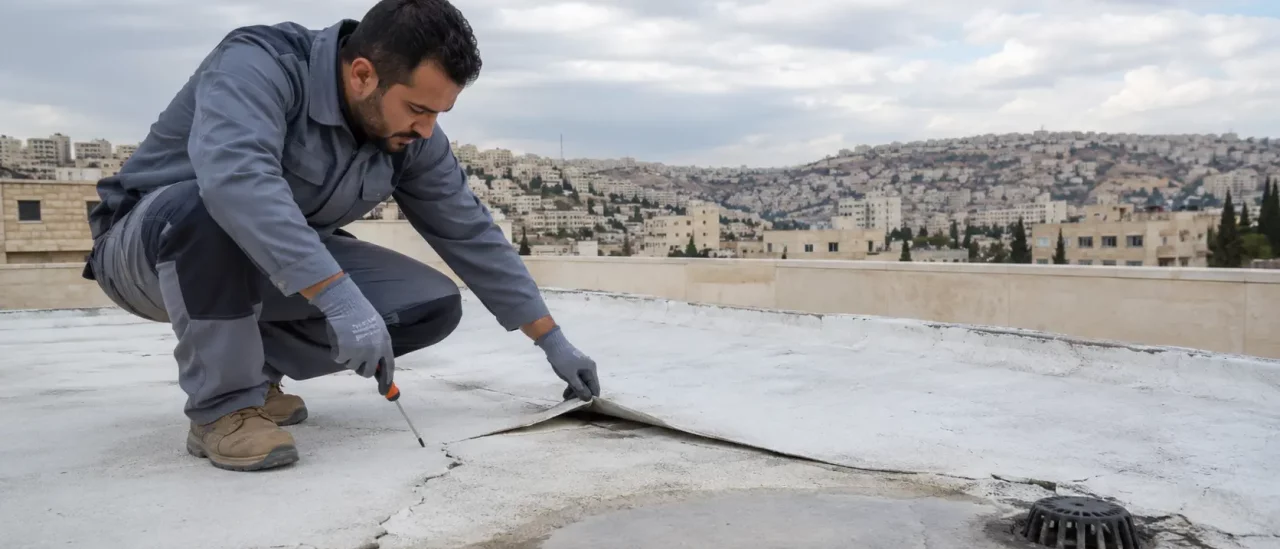
A roof can look fine at a glance while the waterproofing underneath has already started to lose its effectiveness. In Jordan, roofs face a hot, dry summer followed by rain and cold in winter, and this constant change can widen cracks and weaken joints and edges over time. Finding the problem early lets you treat the damaged area before water reaches the ceiling and walls, or before a simple repair turns into a bigger job. In this guide from Al Tamayuz, we look at the main signs of failed roof waterproofing, how to tell a waterproofing problem from a pipe leak, and when you need a specialist inspection.
Why does roof waterproofing fail over time?
Waterproofing is not a permanent layer that is unaffected by the elements. How long it lasts and how well it works depend on the type of material, how well the roof was prepared before it was applied, the thickness of the layers, foot traffic on the roof, and how rainwater drains away. Waterproofing can also be damaged when a tank or air-conditioner bases are installed in a way that pierces it, or by structural cracks and slight movement in the building. That is why you cannot rely on the installation date alone — a visual check after the summer and before the rainy season is an important preventive step.
7 signs your roof waterproofing has failed
1. Damp patches or yellowing on the top-floor ceiling
A dark or yellow patch on the ceiling after rain is one of the clearest signs that water is getting in from above. The patch may be some distance from where the water enters, because water can travel through the layers of the roof before it shows inside. Simply painting over the patch is not recommended — it hides the mark for a while without treating the source.
2. Flaking paint or bulging plaster
When the layers of a ceiling or wall become saturated, the paint can start to flake, or bubbles and bulges can appear in the plaster. If this keeps happening in rooms directly beneath the roof, especially after rain, the waterproofing, edges and drains need to be checked.
3. Visible cracks on the roof
Not all cracks are the same — some are superficial, while others reach layers that let water in. Pay attention to cracks around tanks and air-conditioner bases, where the roof meets the walls, and around drain outlets. Sealing a crack from above with the wrong material may not be enough if the waterproofing beneath it is damaged.
4. Rainwater pooling for a long time
Pools of water that stay on the roof after the rain has stopped can point to poor falls or blocked drains. Standing water puts extra stress on joints and weak spots and can speed up the breakdown of the waterproofing. The drains should be cleared and the falls checked, rather than just sweeping the water away after every storm.
5. Hotter rooms under the roof
If top-floor rooms have become hotter than usual even though your air-conditioning use has not changed, the thermal insulation may be losing its effectiveness. This sign does not prove there is a water leak, but it is worth checking — especially if it comes with cracks or damage to the reflective layer on the roof.
6. A damp smell or mould
A persistent smell in a corner near the ceiling can mean trapped moisture that is not yet clearly visible. Mould should be treated as a symptom of a damp problem, not just a cleaning issue — removing the visible mark inside will not stop it coming back if the source of the water remains.
7. Leaks that return after spot repairs
If a crack was sealed or part of the roof was painted, and the leak came back the following season, the problem may be wider than the visible spot. Sometimes the edges and joints, or a whole area, need to be prepared again and a compatible waterproofing system applied, rather than patching repeatedly with different materials.
How to tell failed roof waterproofing from a pipe leak
When the damp appears gives a first clue. If patches appear or grow straight after rain, the roof, the facade or the rainwater drainage are the main suspects. If the damp continues in dry weather, or is linked to using a tank, a bathroom or a water line, the cause may be a pipe leak. Even so, you cannot be certain from the sign alone — a building can have more than one problem at the same time.
When the source is unclear, water leak detection without breaking helps narrow down the possibilities before you start repairs that may not treat the real cause.
What does a roof waterproofing inspection cover?
- Checking the cracks, joints and edges around the roof.
- Reviewing the rainwater drain points and the roof falls.
- Inspecting the areas around tanks, air-conditioner bases and pipework.
- Assessing the condition of the old waterproofing and how well it is holding.
- Linking the signs of damp inside the building to possible points on the roof.
- Recommending a spot repair or a new waterproofing system, depending on the site.
The right decision depends on the inspection. You may only need a drain cleared and a particular joint treated, or the waterproofing may be past its life and need replacing. That is why there is no single solution that suits every roof in Khalda, Jubeiha, Dabouq, Marj Al-Hamam or any other area of Amman.
Can waterproofing be repaired without lifting the tiles?
In some cases, yes — if the tiles are firmly fixed, there is no water trapped underneath, and the chosen waterproofing system is suitable for application over the existing surface. But loose tiles, wide joints or moisture inside the layers may call for different preparation. Applying a material over an unstable surface may only give a temporary result, so the base must be checked before choosing the method.
When is the best time to inspect the roof?
It is best to inspect the roof during a dry spell before the rainy season, as this leaves enough time for cleaning, treatment and for the materials to cure according to the system’s instructions. An inspection is also recommended after installing tanks or air-conditioners, and after any heavy storm if new signs appear inside the home.
Do not wait for the first leak inside your home
A preventive inspection is far simpler than treating damp that has already reached the paint, the plaster and the furniture. If you notice any of the signs above, take a look at our roof waterproofing service in Amman and Jordan to see the systems available and how the work is carried out.
To arrange a roof inspection in Amman, or to ask about waterproofing, thermal insulation and foam, contact Al Tamayuz by phone or WhatsApp on 0799 747 365. The solution and the cost are confirmed after inspecting the roof and the requirements of the site.