

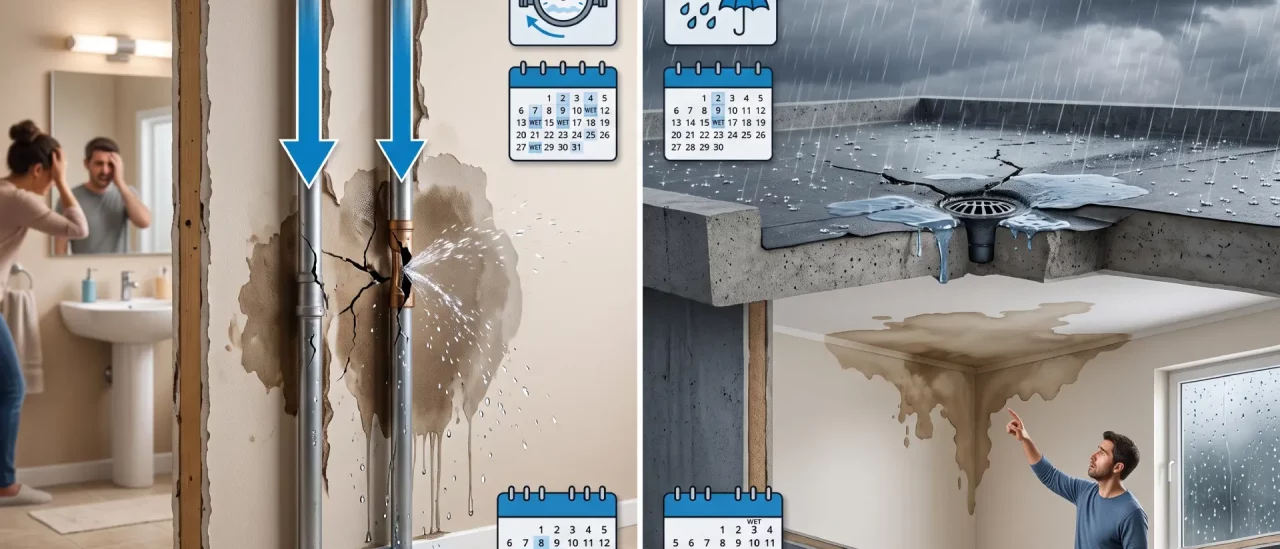
A damp patch on a ceiling or wall does not always mean a broken pipe. In many homes in Amman and across Jordan, the cause may be a leak in the water pipes — or it may be rainwater getting in through the roof or the facade. Knowing the difference before you start a repair saves a lot of time, breaking and money.
In this guide from Al Tamayuz, we explain the signs that help you work out the most likely cause, and when you need water leak detection or when the problem is linked to roof waterproofing.
The first clue: when does the damp appear?
When the damp appears is one of the most important clues. If the patch appears or grows straight after rain and then starts to dry over the following days, a problem with the roof waterproofing, cracks or the drains is more likely. If the damp continues in dry weather or grows when the bathroom or kitchen is used, a pipe leak becomes the stronger possibility.
Does the water meter move with the taps closed?
Close the taps and any appliances that use water, make sure the tank is not filling at that moment, then watch the meter. If the meter keeps moving, water may be escaping from the network. This does not locate the leak on its own, but it helps tell a leak from a pressurised network apart from a rainwater problem.
Where the patch is gives you an important clue
- Below a bathroom or kitchen: the cause may be water or drain pipes, or the floor waterproofing.
- On the top-floor ceiling: a roof problem is more likely, especially after rain.
- Around a window or an outside wall: water may be getting in through the facade or the joints.
- Near a water tank: check the body of the tank, the connections and the valves.
- A persistent patch on an internal wall: this may point to a hidden water pipe.
A quick comparison
| Clue | Pipe leak | Rain / roof leak |
|---|---|---|
| Appears in dry weather | Possible, and constant | Less likely |
| Gets worse after rain | Not necessarily | Usually |
| Water meter moving | May keep moving | Usually unaffected |
| Near a bathroom or kitchen | More likely | Depends on the location |
| Top-floor ceiling | Possible | Highly likely after rain |
Why you should not start by breaking
Breaking before the problem is diagnosed can mean repairing the wrong thing. Fixing an internal pipe will not solve water coming in through the roof, and a new layer of waterproofing will not solve a leak in a pressurised water line. It is better to gather the evidence first and then carry out the right inspection.
When do you need a leak inspection?
Ask for a specialist inspection if the damp is constant, the water meter moves when nothing is in use, the bill has gone up, or the source of the patch is unclear. You can also read our guide to the signs of a water leak under the tiles.
When do you need a roof inspection and waterproofing?
If the problem appears after rain — especially on the top-floor ceiling or near the drains and edges — it is important to inspect the roof, its cracks, its falls and the rainwater outlets. See also our guide to waterproofing roofs against rain before winter.
Frequently asked questions
Can damp have more than one source?
Yes. An internal leak and weak waterproofing can occur together, so the shape of the patch alone is not enough to go on.
Does a thermal camera find every leak?
A thermal camera is a helpful tool, not a verdict on its own. The inspection methods are chosen according to the nature of the problem and the site.
Do I have to wait for rain to confirm a roof problem?
Not always. The roof, its cracks, its drains and the signs of damp can all be inspected — but the fact that a problem appears after rain remains an important clue.
Need to find the source of the damp?
If you cannot tell whether the problem is coming from the pipes or the roof, contact Al Tamayuz on 0799 747 365 to describe the symptoms and arrange the right inspection.